

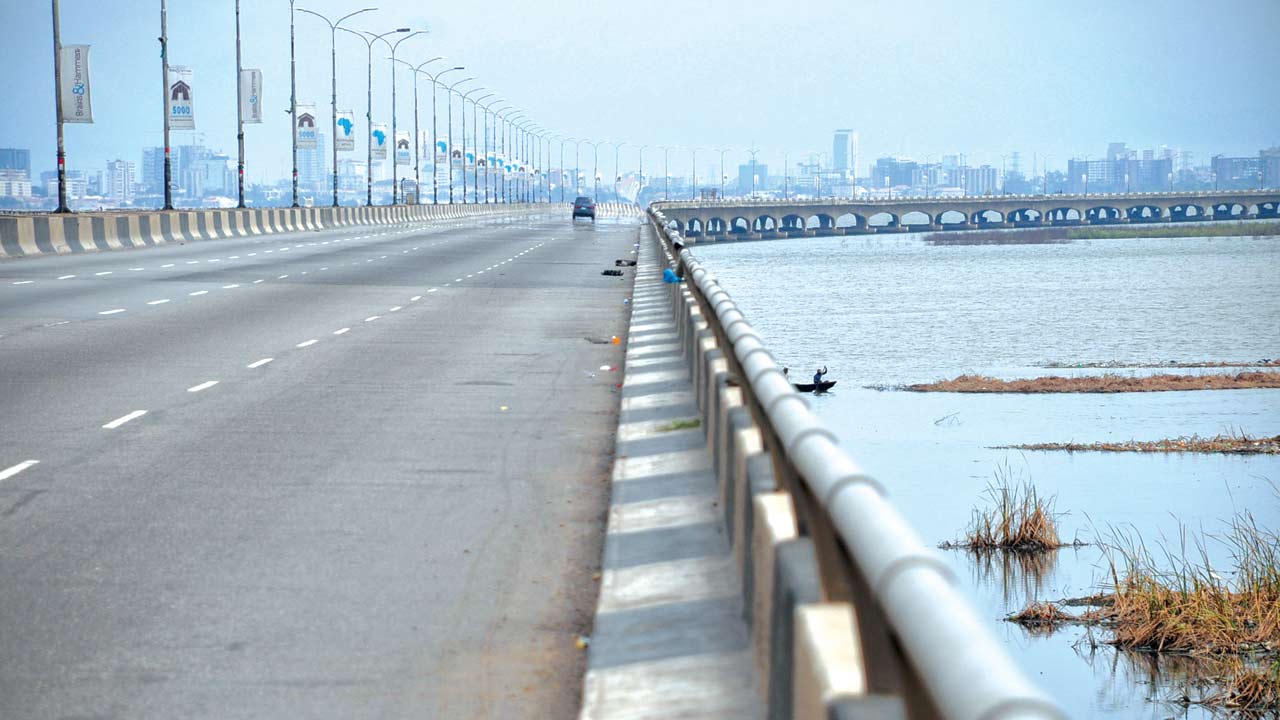
The Federal Government has disclosed that the Third Mainland Bridge rehabilitation will require about N3.8 trillion, after a recent structural assessment revealed severe underwater damage.
Minister of Works, David Umahi, made this known on Wednesday while briefing State House correspondents after the Federal Executive Council (FEC) meeting presided over by President Bola Tinubu.
According to Umahi, underwater inspections carried out in 2013 and 2019 on both the Carter Bridge and the Third Mainland Bridge uncovered extensive deterioration caused by illegal sand mining, erosion, and corrosion of piles and piers.
“When we did a pro rata of what is to be done, if we are to rehabilitate, it came to about N3.8 trillion and if we are to do a new construction, it came to about N3.6 trillion,” he explained.
The proposal builds on prior emergency interventions undertaken on several bridges nationwide. Umahi further explained that the FEC approved the project under the EPC+F (Engineering, Procurement, Construction and Financing) framework, which will involve at least seven specialist contractors to carry out comprehensive investigations, designs, and bids for either rehabilitation or complete reconstruction.
To boost efficiency, the council also approved advertisements for public-private partnerships (PPP) to enable private sector participation in the rehabilitation process.
The scope of approvals also includes work on other bridges such as the Jalingo Bridge (Taraba State), Ido Bridge (Oyo State), Keffi Flyover (Nasarawa State), Mokwa Bridge (Niger State), and a damaged bridge along the Abuja–Kogi road. Further inspections will cover bridges along the Lagos–Ibadan expressway, the Jebba bridge in Kwara, and the Itokin–Ikorodu bridge in Lagos.
At Property Media Week (PMW), we recognise that the Third Mainland Bridge rehabilitation is not just an infrastructure project, but one with significant implications for Lagos real estate values, urban mobility, and investor confidence in Nigeria’s infrastructure sector.


